
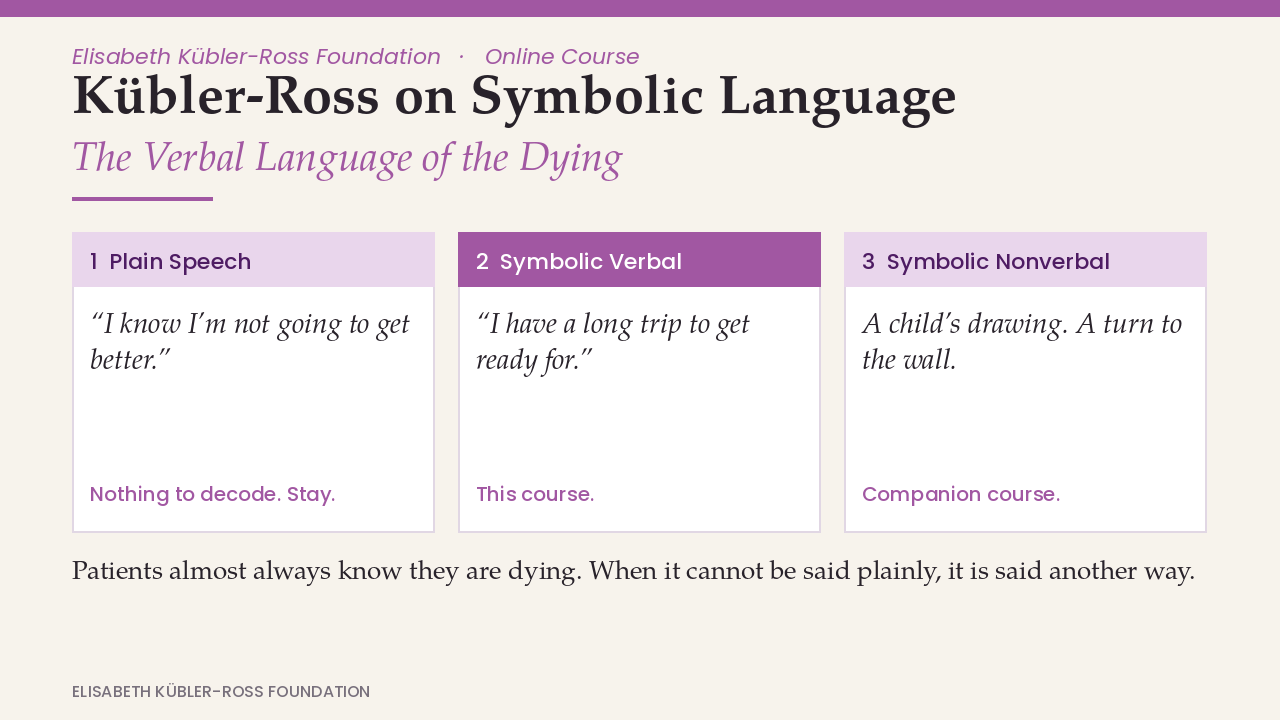
Patients almost always know they are dying. When it cannot be said plainly, it is said another way.
Elisabeth Kübler-Ross learned this in the seminar rooms of Chicago and on the children's wards: the dying speak in symbols. A trip that must be taken. A bear who is very sick. A question about caterpillars. Most of us answer the surface and close the door. This course teaches you to hear what is being said, and to answer inside the symbol, so the door stays open.
What you will learn
- Why the dying speak in symbols: protection, testing, and readiness
- The three languages of the dying — plain speech, symbolic verbal, symbolic nonverbal — and why a change of register is itself information
- Where Elisabeth learned it: from the children of Majdanek to the 1965 Chicago seminars and the children's wards
- Displaced stories, oblique questions, and talk of the already dead: what each sounds like, what closes the door, and what answers inside the symbol
- How to respond when you are the one the patient has chosen to tell
What's included
- Nineteen written lessons across five modules, self-paced, each with a lesson graphic
- Elisabeth's own words throughout, reproduced by permission of her family
- Lifetime access, on any device
Who it's for
Nurses, hospice and palliative care staff, chaplains, physicians, death doulas, family caregivers, and anyone who sits with the dying and has heard something they did not know how to answer.
Companion course: a separate course on nonverbal symbolic language is in preparation.
From the Elisabeth Kübler-Ross Foundation
