
Most of what people believe about the five stages comes from a summary of a summary. This course goes back to what Elisabeth Kübler-Ross actually wrote.
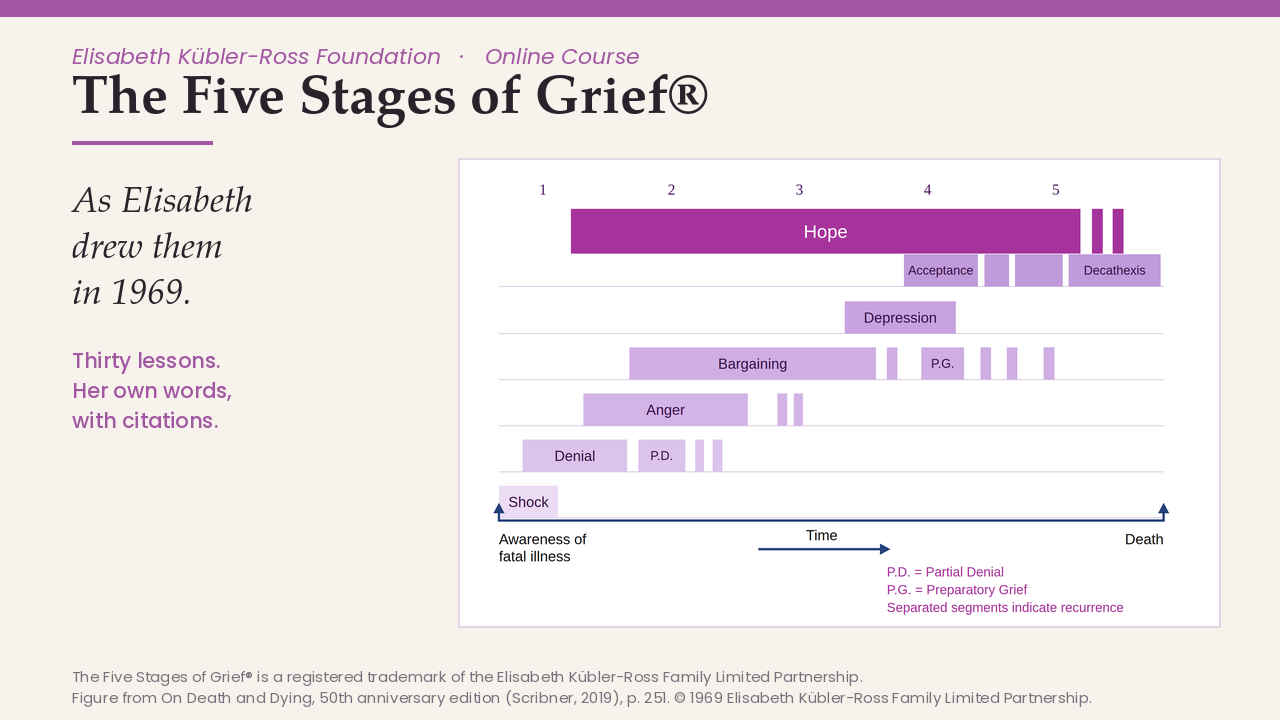
The five stages are the most widely known idea in the psychology of loss, and the most widely misunderstood. They are taught as five steps in a fixed order, ending in acceptance. That is not what Elisabeth drew in 1969, and it is not what she said in the years that followed. This course teaches the model from her own book, her 1973 recorded lectures, and her later writing, with the citations, so you can see for yourself.
What you will learn
- The stages as Elisabeth actually drew them: overlapping, unfinished, with hope running through all of them
- The states the popular version dropped — shock, partial denial, preparatory grief, decathexis — and why they matter at the bedside
- Why she put "stages" in quotation marks, and what she meant by acceptance
- How the model moved from the dying to the grieving, in her words, from 1969 onward
- What the research since has found, and what the criticisms get right and wrong
- How to use the model with a grieving person without turning it into a checklist
What's included
- Thirty written lessons across six parts, self-paced
- Elisabeth's original 1969 figure and the Foundation's lesson graphics
- Excerpts from her 1973 lecture series Lessons from the Dying Patient, digitized from the family's original cassettes
- Direct quotations from her books, reproduced by permission of her family
- Full citations throughout
- Lifetime access, on any device
Who it's for
Death doulas, nurses, social workers, chaplains, hospice and palliative care staff, grief counselors, students, and anyone who has been taught the five stages and suspects there is more to them.
From the Elisabeth Kübler-Ross Foundation
