
Change fails more often than it succeeds — and rarely because the plan was wrong.
It fails because the people living through it were treated as an audience to be convinced rather than as human beings moving through a predictable emotional passage. The Kübler-Ross Change Curve® maps that passage: shock, denial, frustration, depression, experiment, decision, integration. It grew directly from Elisabeth Kübler-Ross's work with the dying and their families, and it has been used in organizations for four decades. This is the first course on the model from the family that holds it.
What you will learn
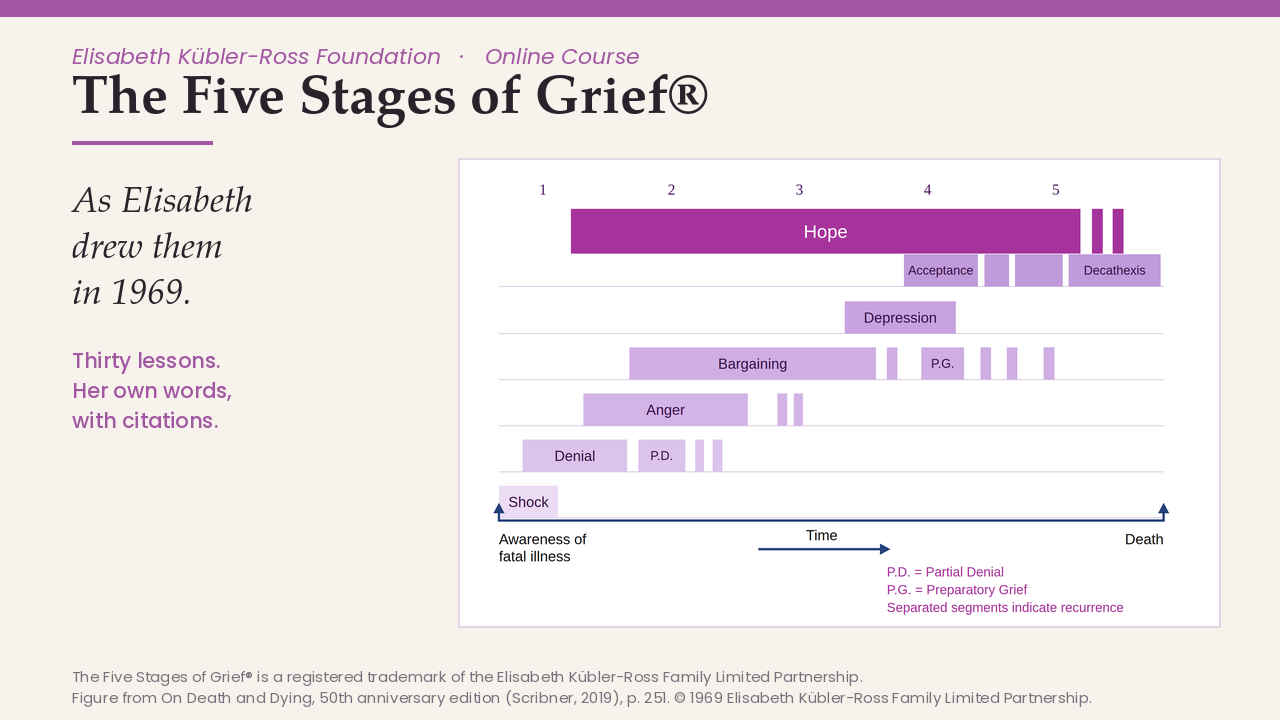
- Where the Change Curve comes from, and how it connects to Elisabeth's original 1969 model of the stages
- What each stage looks like in practice — in a team, in a family, and in yourself
- The two denials, and why explaining change more clearly tends to backfire
- Hope, preparatory grief, and the states most versions of the curve leave out
- How to read where someone actually is on the curve, and meet them there
- Leading a change that is also happening to you
- Where the Change Curve stands among the other models of change and transition
Two tracks in one course
Every module works on two levels: leading others through change, and living through change yourself. Case studies show both sides of the same transition.
What's included
- Written lessons across three modules, self-paced, designed to be completed in under two hours and returned to as needed
- The Foundation's original Change Curve graphic
- Elisabeth's own words on change and loss, reproduced by permission of her family
- Lesson graphics you can save
- Lifetime access, on any device
Who it's for
Managers and team leaders, HR and organizational development professionals, coaches, clinicians, educators, and anyone guiding others through a change, or going through one.
From the Elisabeth Kübler-Ross Foundation
